
01. The idea
A different relationship with technology
Software has become remarkably good at helping us find information, write messages, and make decisions. But most tools still leave the final step to us.
They tell us which number to call, but they do not make the call. They draft a follow-up, but they do not follow up. They suggest how to resolve a problem, but we are still the ones waiting on hold, explaining it again, and remembering to try tomorrow.
Athena starts with a different question:
What if you could explain the outcome you want, and an intelligent assistant could help move the task forward?
Not a set of commands to memorize. Not an endless chat with instructions for every step. A mission, with a goal, context, boundaries, and a clear way to report what happened.
That is the direction we are building toward: an assistant that can take part in real-world tasks, not just describe them.
Our mission
To make everyday action easier by giving people and businesses a capable, context-aware assistant that can handle conversations, pursue practical goals, and keep unfinished work moving.
Our belief
Athena's value will not be defined by how convincingly it talks. It will be defined by whether it understands what matters, knows what to do next, and acts responsibly on someone's behalf.
02. The problem we're solving
The cost of "I'll do it later"
A surprising amount of work does not fail because it is difficult. It fails because it takes time, persistence, and attention that people do not have available at that moment.
Think about the small obstacles that turn a five-minute task into a week-long delay:
- Repetition: Explaining the same issue to different people and departments.
- Availability: Calling during business hours, waiting in queues, or finding a time when both sides can talk.
- Follow-through: Remembering who promised what, when to call back, and what should happen next.
- Coordination: Moving information between a customer, a business, a calendar, and a team member.
- Uncertainty: Not knowing whether a task is finished, blocked, or still waiting for a response.
For individuals, this creates friction and frustration. For businesses, it can mean missed leads, missed appointments, slower service, and revenue that never materializes.
Most automation is good at moving information from one system to another. Real life is messier. People change their minds, answer unexpected questions, ask for alternatives, and sometimes do not pick up the phone.
Athena is designed for that messy middle, where progress depends on conversation, context, and the next sensible action.
03. What Athena does
More than a call. A mission.
Athena is a goal-oriented assistant centered on real-world communication. Phone calls are a primary way it interacts with people and businesses, but the purpose is not to produce a call. The purpose is to help complete a task.
A mission might be as simple as checking whether an appointment is available. Or it might involve collecting information, comparing options, coordinating a time, requesting a follow-up, and returning with a recommendation.
The core experience is designed around five activities:
- Understand the goal. Interpret what needs to happen, collect useful context, and identify any missing details.
- Prepare the approach. Consider relevant information, business rules, limits, and the actions Athena is permitted to take.
- Have the conversation. Place or receive a call in supported workflows, ask questions, respond to the other person, and adapt to what is said.
- Keep the mission moving. Record what changed, identify outstanding steps, and support follow-up or handoff when the task cannot be completed in one interaction.
- Report the outcome. Explain what was accomplished, what remains open, and where the user or team needs to decide or act.
What makes Athena different
Traditional chatbot: Helps you figure out what to say.
Basic voice bot: Handles a scripted interaction.
Athena's ambition: Understands the larger goal, carries context through the interaction, and helps coordinate the steps required to reach an outcome.
That does not mean every task can or should be fully automated. Athena is intended to recognize its limits, ask for help when needed, and keep people in control of consequential decisions.
04. Who Athena is for
For individuals: fewer tasks hanging over your head
Athena is for people who know what needs to be done but do not want to spend their day on the phone.
Examples of missions
- Contact an internet provider to understand a price increase and ask about available alternatives.
- Call a service provider to gather prices, availability, or the documents required for an appointment.
- Follow up on a delayed delivery or unresolved support request.
- Check appointment availability and present suitable options.
- Collect information from several businesses so you can make a decision without repeating the same conversation yourself.
The value: Less back-and-forth, fewer forgotten follow-ups, and more time for things that require your personal attention.
For businesses: conversations that do not get lost
Athena is for teams where incoming calls, outbound follow-ups, and routine coordination compete with higher-value work.
Examples of workflows
- Salons and appointment-based businesses: Respond to routine inquiries, capture preferences, and help fill open appointment slots.
- Sales and service teams: Follow up on inquiries, qualify interest, gather missing information, and route opportunities to the right person.
- Clinics and practices: Handle administrative questions and appointment requests within approved rules, without making clinical decisions.
- Local service businesses: Answer common questions, collect job details, coordinate callbacks, and reduce missed opportunities.
- Operations teams: Check status with suppliers or service providers and bring important changes back to the team.
The value: Faster response, greater continuity, and more consistent follow-through without asking a human team member to personally manage every routine interaction.
Specific workflows depend on setup, integrations, applicable laws, and the current product release.
05. Example missions in action
These examples show how Athena approaches different goals. Each business workflow is configured around its own rules and connected tools.
Example 1. The phone bill that keeps increasing
Audience: Individual
The situation
Your internet bill has increased. You want to understand why and find out whether the provider can offer something better, but you do not want to spend your lunch break navigating a phone menu and repeating your account details.
The mission
"Contact my internet provider, ask why my monthly price increased, and find out whether there is a cheaper plan with similar service. Don't agree to any changes without asking me."
How Athena would approach it
Athena identifies the provider, the relevant account context you choose to share, and the boundaries of the request. During the call, it asks why the price changed, checks available alternatives, and gathers the information needed to compare them.
If a representative proposes a new contract, fee, or commitment, Athena does not make the decision for you. It brings the proposed terms back for review.
A useful outcome
You receive a concise summary: what changed, which options were offered, what each option would require, and the next step. Even if the provider offers no discount, you know the result without having to make the call yourself.
What this demonstrates: Goal understanding, information gathering, negotiation boundaries, and an outcome summary.
Example 2. The salon with an empty appointment slot
Audience: Beauty salon or appointment-based business
The situation
A client cancels a treatment. A desirable afternoon slot becomes available, but the salon team is busy serving other clients. The opportunity to fill it may disappear before anyone has time to contact the waiting list.
The mission
"We have a cancellation tomorrow at 3 p.m. Contact eligible clients on our waiting list, check interest, and help fill the slot according to our booking rules."
How Athena would approach it
With an approved customer list and business rules, Athena can be configured to contact people in an appropriate order, explain the available appointment, capture responses, and check any constraints such as service duration, preferred therapist, or eligibility.
Where calendar or booking actions are connected and permitted, a successful workflow may progress to confirmation. If a client requests something outside the rules, Athena captures the request for the salon instead of inventing an answer or guaranteeing a slot.
A useful outcome
The team sees who was contacted, who was interested, whether the opening was filled, and which exceptions need attention. If no one accepts, Athena provides a clear status instead of silently treating the mission as complete.
What this demonstrates: Policy-aware outreach, conversations grounded in business context, controlled booking actions, and tracked outcomes.
Example 3. The lead that never received a second call
Audience: Small business, sales, or customer success team
The situation
A prospective customer requests information but cannot talk when a team member first calls. The lead is logged somewhere, but no one remembers to follow up at the promised time.
The mission
"Follow up with this prospect, find out what they need, answer questions using our approved information, and arrange a conversation with a human team member if they're interested."
How Athena would approach it
Athena starts with the inquiry details and the company's guidance. It calls within allowed hours, introduces itself appropriately, listens to the prospect's requirements, and records relevant information.
If the prospect asks a question that falls outside its approved knowledge, Athena does not improvise a commercial promise. It requests clarification or hands the matter to a team member. Follow-up rules determine whether another attempt is appropriate.
A useful outcome
The team receives a qualified summary, a requested next step, or a clear reason the opportunity did not move forward. The prospect does not have to start from zero with the next person.
What this demonstrates: Conversational qualification, consistent company knowledge, continuity, and human handoff.
Example 4. An appointment that takes too many calls
Audience: Individual or administrative team
The situation
You need an appointment, but available times are unclear, one provider is fully booked, and the next option requires another call.
The mission
"Check availability for a consultation next week. I prefer late mornings. Give me the best options, and ask before making a booking."
How Athena would approach it
Athena gathers the service requirements and preferences. In a supported workflow, it contacts the provider or checks an authorized scheduling connection. It asks about relevant availability and requirements, such as paperwork or prerequisite consultations.
If there is no suitable time, it can surface alternatives or ask whether to broaden the search. If a slot requires confirmation or personal information, Athena requests the necessary authorization before proceeding.
A useful outcome
You receive realistic options, next steps, or a clear explanation of why the appointment could not be arranged. The task remains understandable even when the first attempt fails.
What this demonstrates: Preference handling, structured information capture, exception handling, and approval before commitment.
The pattern across all four
The point is not that Athena speaks with a human-like voice. The point is that it understands why the conversation is happening and what should happen when it ends.
A call is an interaction. A mission is the work that interaction is supposed to accomplish.
06. How it works
From your request to a real-world outcome
Step 1. Tell Athena what you want.
Describe the result in everyday language. "Find out why my invoice changed" is a mission. So is "Follow up with customers who asked for a callback." You should not need to design a call script from scratch for every ordinary task.
Step 2. Give the necessary context and limits.
Athena needs enough information to act responsibly. That may include who to contact, what to ask, relevant documents or business knowledge, suitable calling hours, what success looks like, and what requires your approval.
Step 3. Athena prepares the next action.
Based on the mission and configured permissions, Athena determines what information is missing and what action should come next. It may request clarification before it calls.
Step 4. Athena has the conversation.
In supported phone workflows, Athena can make or handle a call, respond to the conversation as it develops, collect answers, and use permitted tools or business information to help move the task forward.
Step 5. The mission is tracked, not forgotten.
A phone call might resolve the request, produce a new question, or end without an answer. Athena's mission-centered approach is designed to retain the relevant outcome and support an appropriate next step, including follow-up or escalation where configured.
Step 6. You know what happened.
A good result is not just "call completed." It is an understandable status: resolved, awaiting approval, needs follow-up, blocked, or handed to a person, with the facts that support that status.
Example mission flow
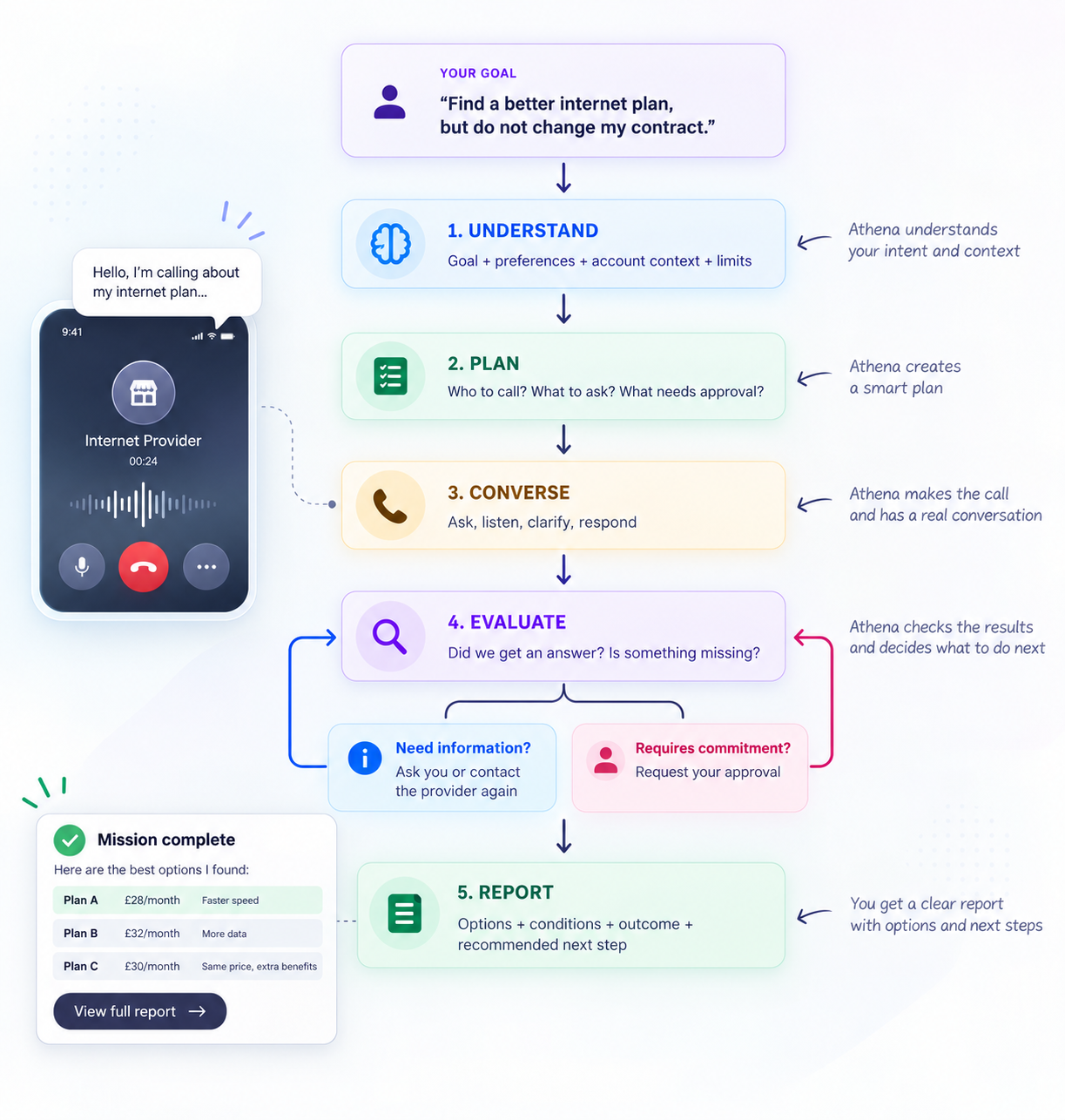
Read the mission flow as text
- Goal: Find a better internet plan without changing the contract.
- Understand: Gather the goal, preferences, account context, and limits.
- Plan: Decide whom to call, what to ask, and what needs approval.
- Converse: Ask, listen, clarify, and respond.
- Evaluate: Check the answer. Ask for more information or request approval before a commitment when needed.
- Report: Show the options, conditions, outcome, and recommended next step.
What if something goes wrong?
A task is not always completed in a single attempt. Someone may not answer, the information may be inconsistent, or the requested action may be outside Athena's permissions.
The intended behavior is to make that situation visible: explain what happened, preserve the useful context, and propose a safe next step. Athena should not invent an outcome, claim a booking that has not been confirmed, or make unauthorized commitments.